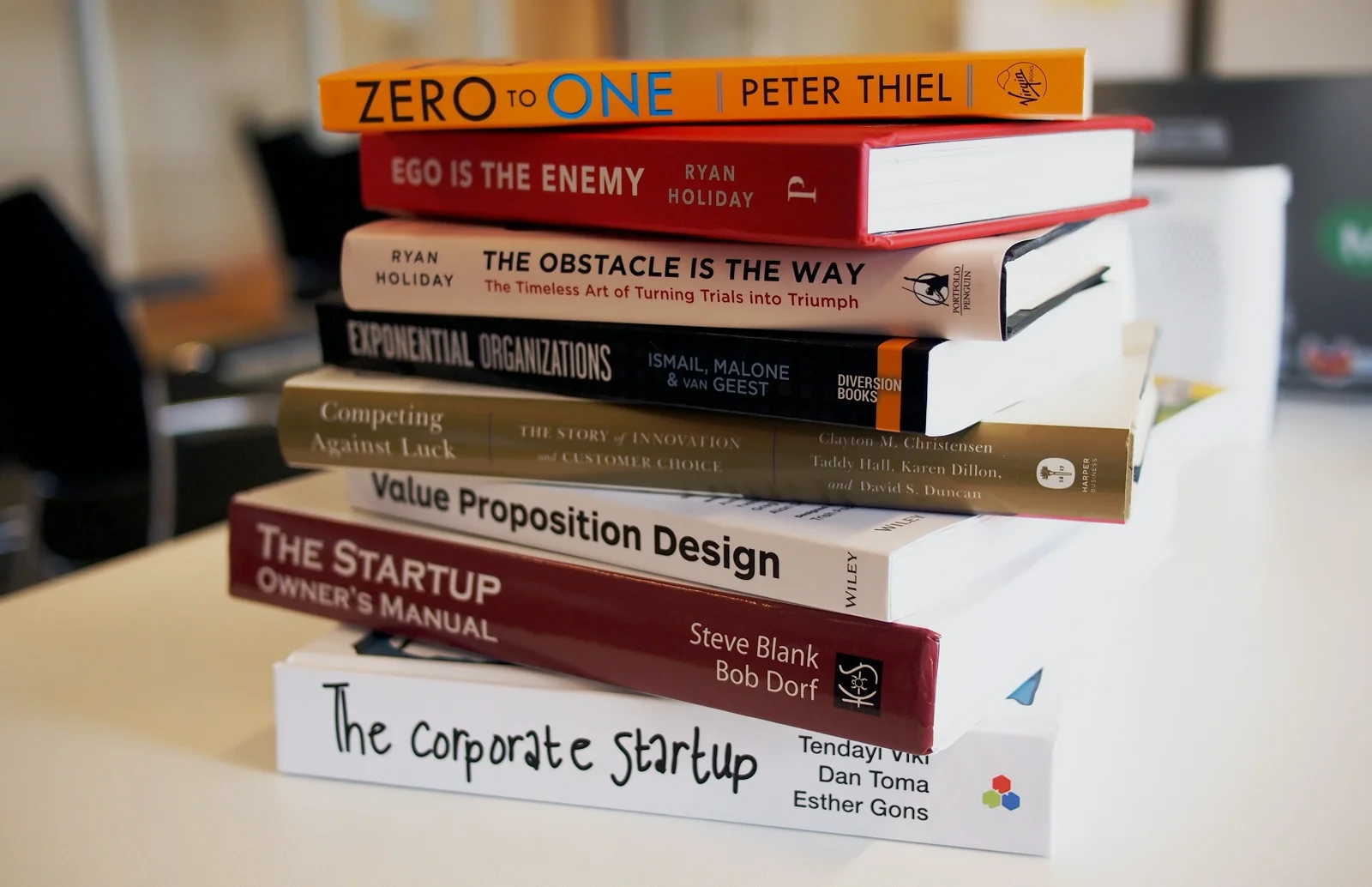
How Startup Founders Can Keep Learning While Running a Company - With No Time, No Peers, and No Margin for Error
June 18, 2026
There are 47 tabs saved in your browser. Articles other founders shared - threads you bookmarked with genuine intent. You haven't opened them in months.
It's not that you don't value learning. It's that you're making decisions from the moment you wake up to the moment you pass out. The market is shifting. AI is rewriting the rules. Your investors are asking questions you don't have fully formed answers to yet. And somewhere between the board meeting prep, the team crisis, and the customer call you took while eating lunch, the idea of sitting down to absorb a chapter on organisational design quietly died.
This is the founder's paradox: the people who most need to learn have the least capacity to do it.
Why Startup Founders Struggle to Find Time to Learn - and Why It Gets Worse as They Grow
The research on founder workload is unambiguous. Harvard Business School tracked 27 CEOs - in real time, 24 hours a day, for 13 weeks - and found they worked an average of 62.5 hours per week, slept 6.9 hours per night, and conducted business on 79% of their weekend days (Porter & Nohria, HBR, 2018).
That's not anecdotal. That's what leading a company actually looks like, measured to the minute.
And the cognitive cost is compounding. Decision fatigue is real - research from the American Psychological Association confirms that task-switching and high-volume decision-making can consume up to 40% of a person's productive time. By the time the evening arrives, many founders can barely decide what to eat, let alone meaningfully absorb new ideas.
The isolation makes it worse. A Harvard Business Review and RHR International study found that 50% of CEOs report feeling lonely in their role - and 61% say it negatively impacts their performance. A separate survey found that 1 in 3 startup CEOs say they have no one to talk to about the hardest parts of their jobs (Inc., 2026). You can't process ideas with your team - they need you to have the answers. You can't be fully honest with investors - they need to see confidence. You can't keep burdening your co-founder - they're carrying their own weight.
Learning thrives on dialogue, challenge, and reinforcement. Founders are structurally deprived of all three.
The result is a category of highly capable, deeply motivated people who know they need to keep developing - and have no format that actually works for how they live.
Why Traditional Learning Methods Fail Startup CEOs - Books, Podcasts, Courses, and Peer Groups
The problem isn't desire. Founders are, almost universally, curious. The problem is that every conventional learning format was designed for conditions that don't exist in founder life.
Books pile up. You buy them with intent. You start them with enthusiasm. Then a crisis hits - a hiring issue, a churn spike, an investor call that needs prep - and the bookmark doesn't move for three weeks. Even on the rare occasion you finish one, the insights fade within weeks because there's no system to bring them back.
Podcasts become background noise. You listen while commuting or exercising, but without active engagement, the ideas wash over you. You can't pause to test your understanding. You can't ask the host to re-explain something. Passive consumption feels productive - and research confirms it largely isn't. The Ebbinghaus forgetting curve shows that 67% of new information disappears within 24 hours without active reinforcement (Ebbinghaus, 1885; replicated by Murre & Dros, PLOS ONE, 2015).
Courses demand a commitment you can't sustain. Executive education programmes require weeks away. Online courses pile up in your queue, half-finished. The structure assumes a calendar that doesn't exist.
Peer groups help - but only partially. YPO, EO, and founder networks are genuinely valuable. They're often the only place founders can speak honestly about what they're carrying. But they meet monthly, not daily. The ongoing development - the frameworks you need this week, the market shift you need to understand before Tuesday's board deck - still falls through the cracks between sessions.
None of these formats were built for learning in the margins. And for founders, the margins are the only place learning can happen.
How High-Performing Founders Actually Learn When They Have No Time - and the System Behind It
The myth is that successful CEOs read 60 books a year. The reality is more nuanced - and more useful.
Warren Buffett built his early edge by spending 80% of his career reading. Bill Gates reads roughly 50 books annually. But both of them had something most founders don't: the luxury of dedicating blocks of time to learning without competing operational demands.
The more instructive data point is this: Tom Corley's five-year study of 233 self-made millionaires found that 88% spent at least 30 minutes daily on reading and self-education, and 63% listened to audio during commutes (Rich Habits, Corley, 2016). They didn't read more because they had more time - they read more because they learned within the constraints they had.
The pattern is consistent: effective founders don't learn despite their limitations. They learn within them. They need formats that work in 10-minute gaps. They need content that connects immediately to what they're working on. And they need systems that ensure knowledge actually sticks when everything is competing for the same cognitive space.
That's not a podcast. It's not a book. It's a companion.
What an AI Learning Companion Does Differently for Founders
Curo is not a course. It is not a podcast app. It is not ChatGPT. It is a proactive AI-powered learning companion - built specifically for the way founders actually work: in gaps, in motion, under cognitive load. (See how Curo works →)
Here's what that means in practice:
-
It fits the margins. Sessions are 10-20 minutes and designed to start and stop at natural points. A commute, the gap between two calls, the ten minutes before a team stand-up. You don't need a cleared calendar. You need a gap.
-
It adapts to what you're working on. Preparing for a fundraise? Curo focuses on financial storytelling and investor dynamics. Navigating a difficult hiring decision? It surfaces what you need on organisational design. The content isn't a fixed curriculum - it's shaped by your current challenges and goals.
-
It builds on any content you bring. Curo can take any material - an article you found, a URL, a document - and transform it into a structured, interactive learning session. You don't have to start from scratch. If you've already found the resource, Curo turns it into something you'll actually retain.
-
It teaches rather than delivers. Sessions are multimodal - voice, visuals, questions, explanations - paced to how you're absorbing the material. Curo checks understanding before moving forward. When you're confused, it re-explains from a different angle rather than pushing on. Roediger & Karpicke (2006) established that active recall produces 80% retention after one week, compared to 34% for passive review - and that mechanism is built into every Curo session, not bolted on as a separate feature.
-
It stays with you across sessions. Curo tracks what you've genuinely understood - not just what you've completed. When you return after three days, it picks up the thread. When a concept from last week becomes relevant to what you're learning now, it surfaces it. This is how knowledge compounds rather than evaporates.
For the first time, having a learning companion that adapts to your context, guides you proactively, and ensures what you learn actually sticks - that doesn't require a mentor, a coach, or a $10,000 executive programme. Curo makes that level of personalised learning available to any founder, at any stage.
What 15 Minutes a Day Looks Like When You're Running a Company
Monday morning, 7:45am - before the day swallows everything. Your Q3 planning session is tomorrow and you want sharper language around AI strategy for your board. You open Curo with a single sentence: I need to understand how to evaluate AI opportunities as a non-technical founder before a board meeting. Within two minutes you're in a structured session - not a search result, not a YouTube rabbit hole. A focused conversation that teaches.
Wednesday afternoon - a 12-minute gap between calls. Curo picks up where you left off. Today: how to frame build-vs-buy decisions on AI features. Midway through, you're uncertain about the distinction between a fine-tuned model and RAG. You say so. Curo doesn't move on. It re-explains with an analogy that connects to a product decision you've already made. You understand it now, not just in theory but in context.
The following Monday - when this would normally have faded. Curo surfaces a short recall check on what you covered earlier in the week - timed to when those ideas are about to begin fading from memory. You remember more than you expected. The one thing you're shaky on gets a brief re-explanation. It firms up.
Board meeting, Tuesday morning. Someone asks about your AI infrastructure strategy. You answer clearly and specifically - not because you crammed, but because you actually understand it. That's the difference between consuming information and building knowledge.
That's Curo. Not a course. Not a podcast. A system that keeps pace with the job.
Curo vs. Executive Coaching, Peer Groups, Podcasts, and ChatGPT: An Honest Comparison for Founders
| Format | What's useful | Why it breaks down for founders | What Curo does differently |
|---|---|---|---|
| Books | Deep, sustained thinking | Require uninterrupted blocks; insights fade without review | Structured sessions in 10-min gaps; built-in spaced repetition |
| Podcasts / audiobooks | Passive consumption in dead time | No retention, no interactivity, no way to test understanding | Active recall built in; adapts when you're confused |
| Courses | Structure, credentials | Require long commitments; abandoned when crises hit | Designed for fragmented schedules; no course to abandon |
| Peer groups (YPO, EO) | Honest dialogue, peer support | Monthly cadence; gap between sessions | Daily companion; available when the question actually arises |
| Executive coaching | Personalised, high-accountability | $5,000-$20,000/year; scheduling friction | Always available; fraction of the cost; adapts to you |
| ChatGPT | On-demand answers | Reactive, no curriculum, no memory, no retention | Proactive; builds your path; teaches and checks understanding |
The honest summary: Peer groups and executive coaching remain valuable for founders who can access them - they address the relational dimension of leadership that no tool replaces. Curo fills the daily gap: the continuous learning that happens between those monthly sessions, in the 10-minute windows that are the only real learning time most founders have.
Is Curo Right for You as a Founder?
Right fit if:
- You know you need to keep developing but every traditional format collapses under the pressure of founder life
- You learn in gaps - commutes, transitions, early mornings - and need content that works in those gaps
- You're navigating challenges right now (a fundraise, a hiring surge, an AI pivot) and need knowledge that connects to what's actually happening
- You want to build genuine understanding of a topic, not just surface familiarity from passive consumption
- You don't have a mentor, a coach, or a peer who knows the specific situation you're in this week
Probably not the right fit if:
- You have dedicated learning blocks and prefer structured, cohort-based programmes
- You're looking for a formal executive credential from a recognised institution
- You want peer accountability and live cohort discussion as the primary structure
How to Start Learning Faster as a Founder - Without Clearing Your Calendar
The founders who will be most capable in five years aren't necessarily the ones who knew the most today. They're the ones who built a consistent learning practice that kept pace with their company's demands - who absorbed knowledge in the margins, retained it through repetition, and applied it before the gap closed.
The knowledge you need to lead well is always slightly ahead of where you are. Curo helps close that gap - not in 12-week programmes, but in the 10 minutes before the next meeting.
Start free at curohq.com → Start with a 7-day free trial—no credit card or setup. Just bring the problem you're working on.
Frequently Asked Questions
How is Curo different from using ChatGPT to learn?
ChatGPT answers the questions you ask, in the moment you ask them. It's reactive - which means the quality of what you get is limited by the quality of your questions. Curo is proactive: it builds a path, teaches in sequence, checks understanding, and ensures what you learn doesn't fade before you need it. It's the difference between a search engine and a tutor.
I only have 10-15 minutes at a time. Is that enough?
That's exactly what Curo is designed for. Sessions start and end at natural points, save your progress automatically, and pick up precisely where you left off. Ten minutes of active, structured learning with built-in recall produces more lasting knowledge than an hour of passive listening.
What topics can I learn about as a founder?
Fundraising mechanics, AI strategy, organisational design, financial storytelling, market analysis, hiring frameworks, stakeholder management, product strategy - anything relevant to your current stage and challenges. You can also bring any content you've already found - an article, a URL, a report - and Curo will transform it into a structured session built around you.
How is this different from a peer group or executive coach?
Peer groups and coaches address the relational dimensions of leadership - they're genuinely valuable and Curo doesn't replace them. Curo fills the daily gap: the knowledge you need this week, in the 10-minute window you have this morning, reinforced so it's still there when you need it next Tuesday. Think of it as what happens between the monthly sessions.
What if I don't know what I need to learn right now?
That's the most common founder state - and exactly what Curo was built for. You don't need to arrive with a learning goal fully formed. Tell Curo what you're working on or what problem you're facing right now, and it will build the path. You can also bring any content you've already found - an article, a URL, a report - and Curo will turn it into a structured learning session built around you.
How is Curo different from listening to podcasts or audiobooks during my commute?
Podcasts and audiobooks are passive - the content flows past you whether or not you're actually absorbing it. Research shows that without active engagement, 67% of what you hear is gone within 24 hours. Curo is interactive: it checks your understanding as you go, re-explains when something doesn't land, and surfaces concepts again at the optimal time for retention. The difference is the same as between watching someone code and actually coding yourself - one feels like learning, the other builds knowledge you can use.
How much does Curo cost?
Curo starts with a 7-day free trial. After that, Pro Monthly keeps your full adaptive learning path, all topics, and progress tracking available. See full pricing →
Can I try it before paying?
Yes. Start free at curohq.com. Your first sessions are available without payment details.
Sources
- CEO working hours and sleep (62.5 hrs/week; 6.9 hrs sleep) - Porter, M.E. & Nohria, N. (2018). How CEOs Manage Time. Harvard Business Review, July-August 2018. Study of 27 CEOs, 60,000 hours of data. hbr.org
- CEO loneliness (50%; 61% say it impairs performance) - Harvard Business Review / RHR International. CEO Snapshot Survey. Widely replicated. See: hbr.org
- 1 in 3 startup CEOs have no one to talk to - Hu-Chan, M. (2026). The Hidden Loneliness of Founders. Inc. inc.com
- Productivity loss from task-switching (up to 40%) - Rubinstein, J.S., Meyer, D.E. & Evans, J.E. (2001). Executive Control of Cognitive Processes in Task Switching. Journal of Experimental Psychology, 27(4). American Psychological Association.
- Ebbinghaus forgetting curve (67% in 24 hours) - Ebbinghaus, H. (1885). Über das Gedächtnis. Replicated: Murre, J.M.J. & Dros, J. (2015). PLOS ONE. doi.org
- Active recall retention (80% vs 34%) - Roediger, H.L. & Karpicke, J.D. (2006). Test-Enhanced Learning. Psychological Science, 17(3), 249-255.
- 88% of high earners read 30+ min daily; 63% use audiobooks - Corley, T. (2016). Rich Habits: The Daily Success Habits of Wealthy Individuals. 5-year study of 233 self-made millionaires.
- Warren Buffett's 80% reading habit - Self-reported in multiple interviews. Confirmed: Columbia Business School talk (widely documented); Becoming Warren Buffett, HBO documentary.
- Bill Gates reads ~50 books/year - Self-reported; widely documented across Bloomberg, Quartz, Time.
`;
const data2 = `## All SEO + GEO Heading Fixes Applied | April 2026
seo_title: "How Startup Founders Can Keep Learning While Running a Company - With No Time, No Peers, and No Margin for Error" meta_description: "Startup founders work 62.5 hrs/week and still need to keep learning. Curo is the AI learning companion built for how founders actually work - in the margins, not classrooms. Start a 7-day free trial." slug: "/blog/curo-for-founders" author: "The Curo Learning Team - educators, product practitioners, and learning science researchers building adaptive learning for everyone." canonical: "https://curohq.com/for/founders" schema: ["Article", "FAQPage"] internal_links:
- /
- /pricing
- /for/product-managers
- /for/self-learners
Ready to start learning with Curo?
Curo turns whatever you want to learn into a personalized, guided board - built around what you already know. Free to start.
Related reading
- How a Founder Can Find Time to Learn and GrowDiscover practical strategies for how a founder can find time to learn and grow, even amidst the demanding pace of startup life.
- Commute Learning: Turn Travel Time into Skill TimeUnlock the power of commute learning with actionable strategies and resources. Transform wasted travel into valuable personal growth and skill development.
- Founder Learning Fundraising: Your Capital GuideMaster founder learning fundraising with Curo. Navigate startup capital, investor relations, pitch deck, and venture capital for your business.
- Curo for Founders: Learning for Strategic SurvivalFounders face unique challenges. Discover how Curo for founders offers personalized, AI-powered learning to master strategic thinking and ensure survival.
- Curo for Startup News Learning & Actionable InsightsLearn how Curo helps founders master startup news learning, filter market trends, and gain actionable insights for business growth and strategy.
- Learn with No Time: Strategies for Busy LivesDiscover actionable strategies to learn with no time. Integrate continuous learning, skill development, and personal growth into your busy life effectively.
